Pages

Showing posts with label writing. Show all posts

Monday, April 23, 2012

In Honor of The Bard


I just learned from the SOURCES of ALL SOURCES - a.k.a. the Twitterverse - that it's Shakespeare's birthday (and deathday, actually). Obviously, this gives me an excuse to tell you ALL my thoughts on the Bard.


1.
I love Shakespeare with true passion. Not the kind of passion where you see all your friends reading Kerouac, and you grab a copy of On The Road from the used bookstore to fit in. The kind of love which had me toting around my uncle's Shakespeare textbook the summer before ninth grade. It inspired me to take two Shakespeare classes - once in high school and again in college. It even makes Twelfth Night comfort reading.

Yes, that makes me a dork. And an English major. I'm okay with that.

2.
Okay, to be perfectly honest, I love his comedies and a select few of his tragedies (not Romeo & Juliet, which I had to read multiple times for school). The histories always fail to hook me in the first Act. Also, they're histories. The word itself implies epic multiple choice tests and long essays on Queen Elizabeth I, not awesomeness.

3.
Now, a ton of people will tell you that middle grade readers can't read Shakespeare. And I don't recommend you passing your ten-year-old a fancy antique copy of King Lear and expecting them to wow you with memorizing the best parts.

But my parents did me a favor early in life. They gave me a copy of Charles and Mary Lamb's Tales from Shakespeare.

My copy didn't look like this, but I wish it did.
Look! This is obviously for kids!! And JUDI DENCH wrote the intro!!!  

Now, you hear the Shakespeare purist screaming, "Nooooooooo, don't let them read it! Those Tales butcher the Bard's beautiful poetry! You must only read Shakespeare's plays in their original form!"

Ignore that dude. He doesn't know what he's talking about.

Shakespeare was a storyteller as much as he was a poet. Tales from Shakespeare boils the plays down to their stories.

For a kid, language is beside the point; stories are the good stuff: Viola dressing up like her brother and getting into all sorts of scrapes because people think she's a girl; two couples running into the forest and tangling with the King and Queen of Fairies; three witches popping into MacBeth's life and telling him he could be king; Hamlet's uncle murdering his dad to usurp all of Denmark and Hamlet running around trying to figure out what to do about it; Prospero shipwrecking his sneaky brother on his island and sending Ariel to mess with his head. This is not like George Eliot, writing about a bunch of people talking in a place in England called Middlemarch (love that book too, btw). These stories are EPIC. They're as accessible and riveting as fairy tales

When you're little, you see Shakespeare painted on the wall in Barnes & Noble, and you figure he must be a good writer. No one tells you that he writes about AWESOME STUFF. Tales from Shakespeare whets your appetite for more.

Reading Tales from Shakespeare does one other thing for you: when one of your teachers finally assigns you MacBeth in tenth grade, you know what it's about without having to go check wikipedia first. Knowing the plot makes it so much easier to understand what's going on in each scene. Which brings me to my next point.

4.
Reading Shakespeare's plays can feel like reading in another language. Why? Because it IS another language.

Elizabethan England was half a millenia ago!! The awesome thing about language is that it's always adapting, evolving to fulfill our needs. For example, two decades ago, email wasn't really in everyone's dictionaries. And nobody knew what Expelliarmus meant. And some words go out of style - I still don't fully understand what an 8-track is, for instance.

In the five centuries or so from Shakespeare's day, we've lost a lot of words and phrases. That's why any copy of a Shakespeare play worth its salt has a glossary.

Any kid in French class can tell you reading in another language is slow-going. You have to look up every other word, especially at the start. That's mainly why people give up on Shakespeare. It's hard to figure out what's going on.

But any good French student will tell you that it gets better with practice. You start understanding the rhythm of the sentences; words that looked foreign suddenly make sense: "Anon" starts to mean, Wait a sec! and "I prithee" starts to look like, Come on, pleeeeaaaasssseeeee in your head.

So, hang in there, young Shakespeare reader. Keep trying. It's totally worth it.

5.
I bet you're waiting for me to tell you what Shakespeare means to me as a writer. All writers end up here at some point, thanking the Bard for his awesomeness, and I'm no different. When I think of what Shakespeare taught me, I think of a few things:

The first is how to use dialogue properly. Dialogue in any story should either a) move the plot forward, or b) reveal character. Actually, it's better if you can do both at the same time.

Shakespeare's plays do both. In fact, they do that all the time, pretty much in every line. Why? Because in a play, words are basically the only things on stage. You don't have a close-up of the actor's face to reveal emotion like in a movie; you don't watch the character's thoughts unfold like you do in a short story; you can't learn his backstory like in a few leisurely pages like you do in a novel.

Shakespeare had to use his words, and he does it splendidly. You can learn from him, people.

Joss Whedon - creator of Buffy, the Vampire Slayer and Firefly - says this about Shakespeare's dialogue too, btw. Check out this interview.

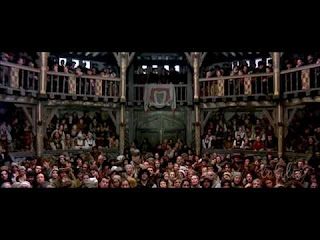
Shakespeare in Love - awesome film.
But LOOK AT ALL THE PEOPLE IN THE THEATER!!!
Ground floor = cheap seats.
The box seats = the nobility and the wealthy.

6.
I learned one important thing in my high school class. It came from an awesome short book on Shakespeare, the name of which eludes me right now, but Ms. Todd - my teacher - drove it home:

Shakespeare was popular in his own time, because he included something for everyone

He had the romance for the noble ladies betrothed to old dudes they'd never met; slapstick comedy for the working people who wanted a laugh before going back to their daily drudgery; intense power struggles for the politicians who tagged along to the theater after Queen Elizabeth I; flourishy language for the poets who kept trying to impress each other with their sonnets; dirty jokes for the teenage boys sneaking away from their apprenticeship duties; sword fights for the people who craved blood and action sequences; plus some fantasy, some ghost story, some family disputes.

In short, he didn't think of himself as an artist, who had to protect and nurture his pretty pretty words. He thought about his audience. He knew he had to entertain them, so they'd tell their friends and come back for more.

But he didn't stop there. He also worked from the big themes, tackled the big questions: how love can cause both jealousy and joy; the death of innocents and the rise of the greedy; the corrupting nature of power; the fantastic nature of life itself, etc.

Whenever critics dig their claws into popular literature for young people, I want to tell them this:

Like the Bard, you can do both at the same time. You can entertain, and you can capture the terrible wonder of being human. Stories like that transcend the telling. They step inside you and change the way you understand the world.

Shakespeare did that for generations.

Thanks, Will. You're my superhero.


Sunday, April 1, 2012

March: The Month of In-Betweens

I spent March In-Between: in between Winter and Spring, in between long drives, in between revisions, in between visits, in between finishing one book and promoting its prequel, in between apartments, in between traveling and building a home, in between one chapter of my life and the next.

(Wow, you know when you write a word so many times that it starts to look foreign, like maybe you haven't spelled it right. That just happened to me and "between." :-P) 

It's not a bad place, but it's definitely busy - and not exactly full of interesting activities.

But today, because I was driving down from Seattle and my mind had a little mental free time, I thought about how many stories have In-Betweens, especially in fantasy and scifi. A place, a portal, or a passage, which is the dividing line between one thing and the other.

For example, Lucy and her siblings must go through the wardrobe to reach Narnia in the Lion, the Witch, and the Wardrobe.

Found the image here,
but I think the illustration credit goes to Pauline Baynes.
But my favorite In-Between place from C. S. Lewis is the "Wood Between the Worlds" in The Magician's Nephew, an in-between place filled with trees and with small pond-like pools. Each pool took you to a different world; all you had to do was jump in it.

In The Girl Who Circumnavigated Fairyland (In a Ship of Her Own Making), September passes through the Closet Between Worlds to reach Fairyland.

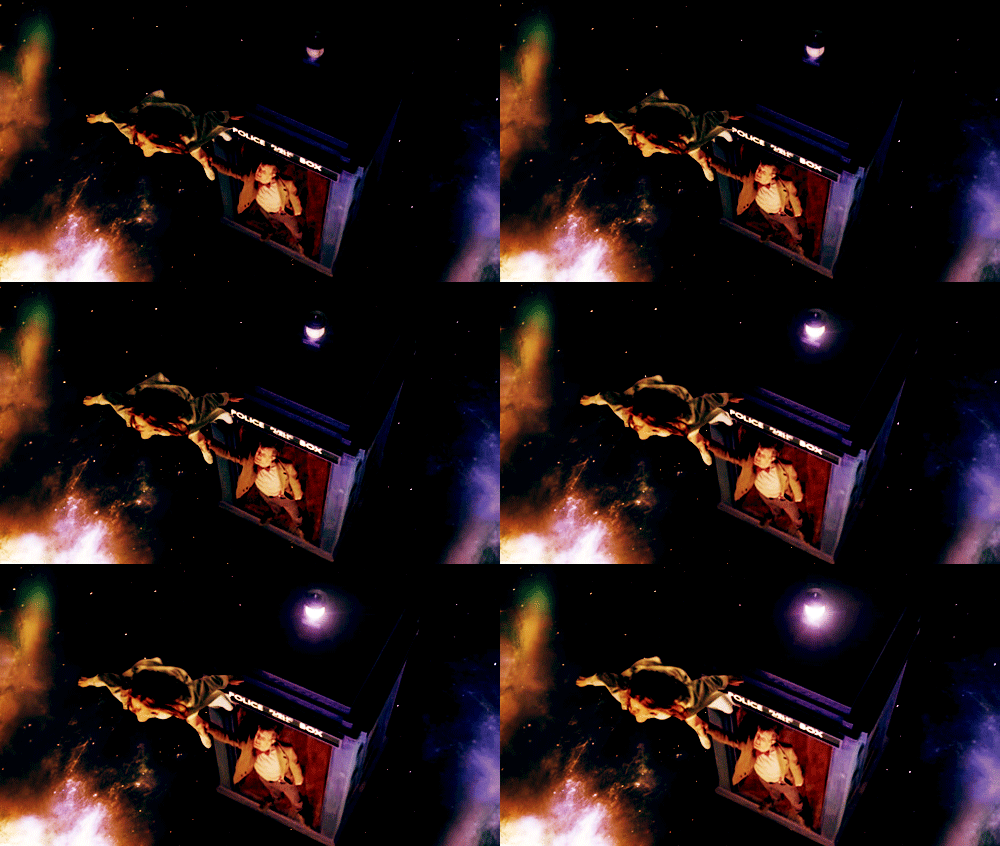
From "The Beast Below" -
a.k.a. one of my favorite episodes.
You could argue that the Doctor's Tardis is an In-Between (you could also argue that it's a vehicle, though; or if you've watched Series 6, she might also be a person). But it's there at the beginning and end of every adventure.


The In-Between in Spirited Away is the abandoned amusement park Chihiro and her parents stumble upon, and I love the way it felt magic even before any of the creatures appeared.

Alice has her rabbit hole, and her looking glass. Both In-Betweens take her to Wonderland.


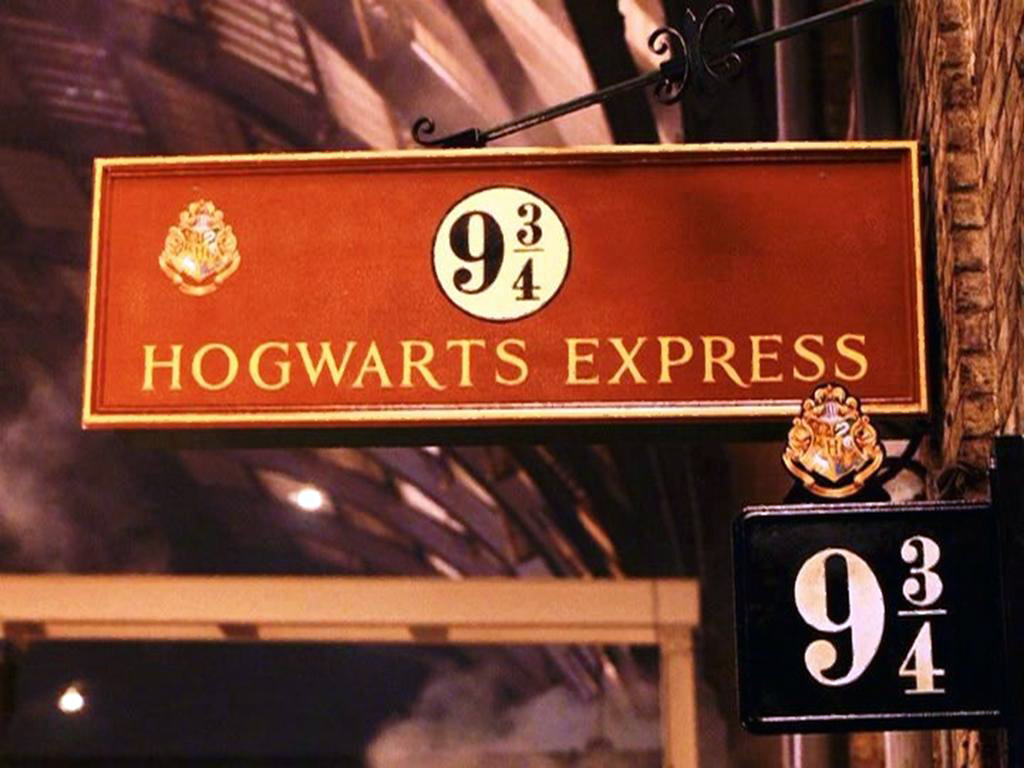
Harry Potter's In-Between is the Platform 9 3/4.

Even The Ever Afters has In-Betweens - the first of them is an ordinary red door, which takes Rory to Ever After School for the first time and changes her life forever.

Storytellers love In-Between places. That's where the end of something familiar touches the beginning of something new. They mean change, and change almost always means conflict. Conflict means story.

That's where I am right now. I'm in the middle of a lot of change. I'm sure I've passed through In-Between months before, but this time, I noticed it happening. I paid attention, took notes - I'll use it as book fodder someday.

Right now, here In Between, I'm too close to my story to be able to tell it properly.

Instead, I'll leave you with a quote:

“When in doubt, choose change.” -Lily Leung

Tuesday, December 21, 2010

After the Race

I know. I've been completely MIA for - *pops out to check archive* - over a month and a half.

(I haven't even been tweeting regularly. Seriously, how hard can 130 characters be?)

A part of me is ashamed of my bad blogging self. But a bigger part of me acknowledges that stepping away was completely necessary.

In the fall, I hit a major milestone: my first deal. This was a dream that was nineteen years in the making. (I would say twenty-four years in the making, but that would be cheating. Before the age of five, I technically didn't know what a writer was.) I had every expectation - every inclination - to jump in the blogging pool and swim some victory laps...ahem, I mean, write inspirational, moving posts.

But I didn't.

Instead, it really felt like finishing a race. Not a nineteen-year race, because that's just silly. But a fourteen-month race, one that started July 2009 when I first had the idea for EAS and realized that this was the story that begged me to try to get it published. (Previously, I had only written for myself and writer workshops and maybe a small circle of trusted, book-loving friends.)

To be more specific, getting published is like one of those long distance races - the endurance events where your time almost doesn't matter: only getting to the finish line is important.

Those of you who have been in races - both the running and the publishing kind - can see while the analogy comes in handy. You have this goal (to finish/get published), but if you're like me, the big goal is was too overwhelming to approach head-on. You have to break it down into smaller goals. In other words, while you're running and running, your vision tunnels to one thing - the next mile-marker, and a voice chants in your head, Come on. Keep going. If you can get to that sign post, the one where people are cheering, you'll be a quarter of the way. There won't that be awesome? (And then, if you're me, you also promise yourself that you can stop, take a short break, and catch your breath. But maybe that's just me. I'm a terrible runner. I have to lie to myself to trick my body into not stopping.)

These were my "mile-markers:"
Now, I don't know how it is for other people, but for me, the last fourth of the race is always, always complete hell. My entire mind is reduced to the thud of my feet against the asphalt, the stitch in my side, my ragged breathing, and the effort of forcing one leg to move, then the next, and the next, and the next...

My eyes may be on the finish line, but despite my determination to get there, I am fully aware that my body - or in the case of this extended metaphor, my manuscript - may give out. For some races, it's simply not your day to reach the finish line. You'll have to stop, cut your losses, regroup, and start the race all over again on another day (usually with a completely different manuscript).

I don't know any of these girls,
but I wish I could run like them.

I lucked out. With the hard work of the amazing Jo, my manuscript made it to the finish line...and took me along with it.

The finish line feeling is pretty cool: the people closest to you are patting your shoulder telling you what a good job you did, but your body still feels like you're running. You kind of can't believe that the race is actually over; your blood is thumping in your ears; and you have to take a few moments to get air back in your lungs and slow your breathing before you can actually talk to people.

I barely remember the day the deal happened; the strongest memory is a sense of disbelief and breathlessness.

But the really, really awesome feeling is a few minutes after the finish line/days after the deal: the endorphin hits you like a ton of deliriously happy bricks. You feel relief. You feel triumph! You made it! You accomplished your goal. You have so much energy - more than you expected to have after a long race. The world is at your feet, and nothing is your life is impossible. This is when most of the best celebrating happens.

(And I'm sorry, dear blog reader. I didn't post anything in the celebratory phase besides the announcement post. A lot of the elation was spent dancing around in random places and treating myself to way more Pinkberry than is healthy.)

And then, something else happened. It happened to me the same way that it happens after finishing a race, but I haven't heard about it happening to others. (Maybe I was in the unique position: I had the book deal, but since I didn't need to start revising right away, I had some free time.) ((Or maybe I just haven't been in the blogosphere for a while.))

After running a race, after the elated period, the endorphins wear off, and all you can think about is bed. Maybe you also debate about how necessary it is for you to take a shower and rinse off the race sweat before climbing under the covers, but bottom line: you need sleep, and you need it ASAP.

Actually, this is me. I think.
Probably before the age of 2.
(I don't have many pics of myself sleeping - go figure. :-P)


Readers, a week or so after the book deal, I crashed - completely exhausted.

I have workaholic tendencies. (I'm not sure if I mentioned this or not - I hesitate to mention it now. I have a no complaining policy on this blog, and writing this comes pretty darn close.)

For a long time this summer, I didn't even pay attention to to how much time I spent working. I took breaks only to visit the gym, or to take pictures of the bear, to watch SYTYCD, or to call my parents and tell them that I didn't get eaten by the bear. Realizing something is wrong, I started to keep track of my hours in July, and I sincerely hope that it was the height of my unhealthy pace: I spent 10-14 hours a day working at my revising desk. I didn't take weekends. I actually only took three days off that month, and two of them, I spend driving to and around town for supplies.

(This was the last fourth of the race, the difficult part.)

Anyway, after the deal, early in October, I was so worn-out that I actually told Jo that was going to take a month off, because I didn't know when I would get another opportunity to take a break. I did, and it was enormously helpful.

But my body was greedy and wanted more rest. When I jumped right back into work early in November, I quickly got a virus. Which turned into a sinus infection, and I spent two solid weeks in bed. Feverish. Reduced to a diet of soup, Motrin, and as many movies and TV-via-internet shows as my computer would allow.

Now that I've recovered and have moved past the crashed stage, a completely new feeling has taken over. You know, like the day after the race - when you put Band-Aids on all your blisters, put up your running shoes, and start tackling all the errands and the homework you made an executive decision to ignore until you passed that finish line (or not). You still feel good - ahem, just a wee step down from giddy - about what you've accomplished, but the tunnel vision has disappeared. You have other things to do.

Let's call it the Okay, now what? feeling.

Part of the answer is obvious. I was extraordinarily lucky: I have a two-book deal, which means I have one ms to revise and another to write (and then revise). That part is well underway. (Woot!) I'm confident that I can handle that.

Another part of the answer is just as obvious: after the past year, I can see that the work isn't the problem. It's the way I work. I can't spend the rest of my life working at the pace I did in 2010. So, I'm trying to strike a healthy balance between working and living. (I was happy to see some awesome posts, where other industry peeps encourage others to do this: Veronica Roth, Molly O'Neill, and Meredith Barnes.)

Here's where we get to the murky part.

I have finished the race. I have accomplished my dream - a dream, you remember, has been nineteen years in the making. I won't lie. This dream has defined most of my life - at least the parts I had control over. I can be shockingly single-minded like that.

Even though I still feel incredibly lucky and blessed, the question I keep asking myself is "Okay, now what?"

I don't have the answer.

At least, I don't have a complete one. Not yet. But I do know this: dreams change and grow, same as people do. Yes, I have accomplished the dream of becoming a published writer. But the dreaming has not stopped. Now that goal has been reached, I'm uncovering a whole bunch of dreams that were less pressing. I'm starting to realize, Now that I am an author (*grins*), I have to discover what kind of writer I am...and what kind I want to become.

That's no small feat. Especially when you're only twenty-four and you're just now beginning to understand who you are as a person - let alone what you have to offer as a writer.

I will be honest. It scares the heck out of me. But so did leaving New York, and querying, and going on submission.

It's just another race, really. But this one is even longer. Maybe as long as a lifetime.

Wish me luck.

Because I have ever intention of taking all of you with me...in a blogging way, of course. :-P

Friday, April 30, 2010

Journals!

(Ignore the 1.'s below. This started out as a regular Friday Five post, but when the journal idea grew and grew, Blogger didn't want to give up its numbers.)

My agent-sister Linda Benson has a lovely post about journals, and I thought I would give it a go as well.

I didn't always keep a journal, but I always liked the idea of writing in them and feeling all writerly. As a kid, I would start them and then forget them. One, which I started during spring break in third or fourth grade, starts with a detailed and earnest catalog of all the seashells I found on the beach that day, and ends three pages later.

Those are the seashells, fyi - in between my brother, sister, and me.
(I'm the one in the blue nightgown.)

Then, during my senior year of high school, my homeroom teacher made me read Natalie Goldberg's Writing Down the Bones and Anne Lamott's Bird by Bird, and one of these (not sure which anymore) said that the best way to keep yourself writing was to make sure you always had a journal. Even if you didn't have time to write short stories constantly, or (gasp!) novels, you could put something down on paper and keep your creative juices moving around in the right way without the pressure.

I was quite taken with this idea. Suddenly, I became a dedicated journal carrier, and I haven't ever looked back. I don't know if they actually do help my writing, but they've become a necessity - part confessional, part travelogue, part chronicle of all the changes in my life (even crises that I eventually forget ever happened). I write almost daily, and on days I don't write in them, I feel flat and strange. Re-reading these journals are amazingly helpful when I want to draw on personal experience. I have a terrifically terrible memory, especially for hard times, so rereading my angst helps me recognize ALL of what I felt at that particular moment.

I'll finish my current journal probably in the next week, the same journal I started on the day I started this blog - Thursday, August 20, 2009. Just in case you're wondering why this is an accomplishment, take a look:
    It's mammoth (500 pages, I think). Here's a side view - each Post-it represents the start of a new month.


    Inside, the pages are lined like graph paper, so my handwriting ends up being neat and tiny. (This is important. I'm vain about my handwriting.)


    But it's not all filled with my own notes. Sometimes I cheat and tape in printouts of new discoveries I want to keep.


    For instance, here is J.K. Rowling's 2008 Harvard Commencement Address, "The Fringe Benefits of Failure and the Importance of Imagination." I had heard of this speech, but I hadn't seen or read it. (If you haven't, you SHOULD. She's self-deprecating and inspiring and generally full of awesome.) The handwriting on the side are my comments, ie. personal response.
Okay, I've also gotten smaller, skinnier, and more colorful journals and finished them happily in a few weeks. In fact, this particular kind of journal - which hails from a fancy Spanish stationer, and which I buy from my local chain bookstore - only gets toted around during certain times in my life.

The special events, the big changes, where I want to keep a record of all the transitions in one place, and I know that finishing it, I'm not the same girl-woman/writer/person I was when I began at page one. So far, I've started these behemoths only three times - the first week of studying at Oxford University during junior year of college, the summer after I graduated from college, and most recently, the day I left my job in New York and began life as a writer.

I don't think a lot is going to happen in the next week, so as I glance at the opening pages, I'll just share a few ways I've changed:
  1. I'm less terrified and more sure of myself and my path. When I left New York, I wasn't completely positive that I was doing the right thing. The only thing I was sure about was that I couldn't continue the way I was going. Now, the future feels a little less like stumbling in the dark and more like chasing the light at the end of the tunnel.

  2. I know a heck of a lot more about my current writing process, which includes revisions. The last novel I wrote before my current WIPs, I finished in August 2006, and revising those chapters was basically re-reading them for typos. Dedicating myself to turning a first draft into the best novel it can be is totally different. For one thing, it's a lot slower than I thought.

  3. Related to my speed, I am beginning to realize my limitations as a writer. Not so much the quality of my writing, which can only improve and improve, but the volume of work. As it turns out, I can't do everything. Which means, at some point, I'll have to learn to say no - even to myself.

  4. Leaving New York, I had this vision of myself, living alone in a small town and just knocking out huge chunks of work. Now that I made that vision a reality, I realize that it doesn't work. In short spurts, it's hugely productive - that's how I finished two manuscripts in a month. As a lifestyle, I end up tweeting and blogging about the weather, because that's the most exciting thing happening at the time. Living like that long-term (ie. longer than a few months) isn't going to work out.

  5. At first, I called changing my life an act of desperation, but desperation has turned into determination, a daily routine of stubbornness. I haven't yet figured out if this is an improvement or not. I'll let you know after the next journal.
(Wow, look at that - this ended up being a Friday Five after all. :-P)

Thursday, December 3, 2009

The First Day

Today has been devoted to altitude sickness.

Which basically means that I gave myself permission to be lazy on my first day up the mountain. And I kept a glass of water next to me at all times. I lost count of how many I drank.

I don't mean that I haven't done anything with my day. I unpacked. I typed up all the manuscript scribblings that I have. I added two new scenes. I did a little yoga. I called my sister twice, because it's her birthday. I received a bunch of calls - from my father, my uncle, my ex-roommate, and my mother - all of them worried that I might be lonely.

I wasn't lonely. It was just too quiet. Cars rarely travel this far up the mountain, and the snow muffles sound. If I had moved here straight from New York, I might have gone a little nuts, but Charlotte was a good transition. Now it's easy to fill up the silence. I watched two movies. While I unpacked, I turned up my iTunes and sang along as loud as possible.

This is where I'm hanging out.

My view. I know - it's a hard life.

My library. I packed forty-some in my luggage, which surprised me when I counted.
I expected there to be at least 50. Don't worry. I'll get more. :-)


My writing nest. Usually, the blanket goes over my lap.

The cold is still a problem. I emailed back and forth with my coworkers about it. I heard a rumor en route that it was negative twenty up here, so I was relieved when I woke up to five whole degrees. (Yes, still pretty sad, but better than being below zero.) It doesn't look like I'll be skiing for a little while. :-/

I'm relieved to be here, where writing is the whole point. My dad called this the first day of my new life, and I think he's right. This is where I can get really serious about my writing career and put that seriousness into action.